

From productivity to serenity, part 3: Serene Performance, the full recipe
This article is part three of a series about “Serene Performance”.
We explore a universal framework that helps to achieve progress on your goals while keeping a calm state of mind, putting an end to unproductive stress and hustle.
If you haven’t yet read part 1 of this series, read this first: Part 1.
Serene Performance – a three-ingredients recipe for calm and meaningful productivity
Let’s unpack the full framework. Remember the composition of Serene Performance from three different elements:
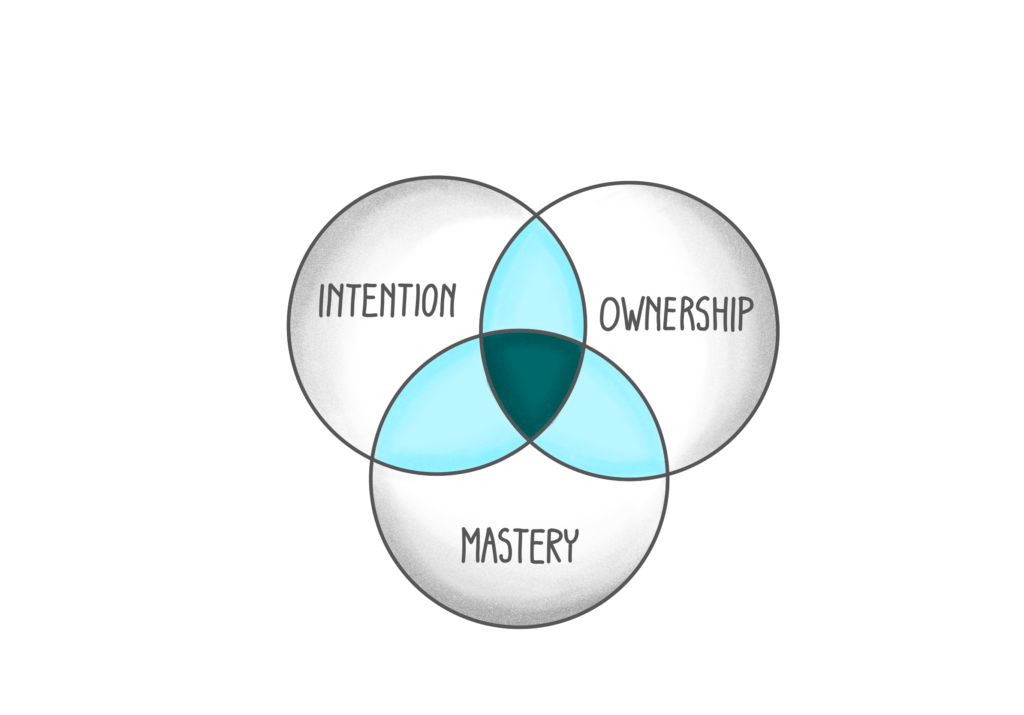
Serene Performance = Intention + Ownership + Mastery.
sP = I + O + M.
What happens if one element is missing?
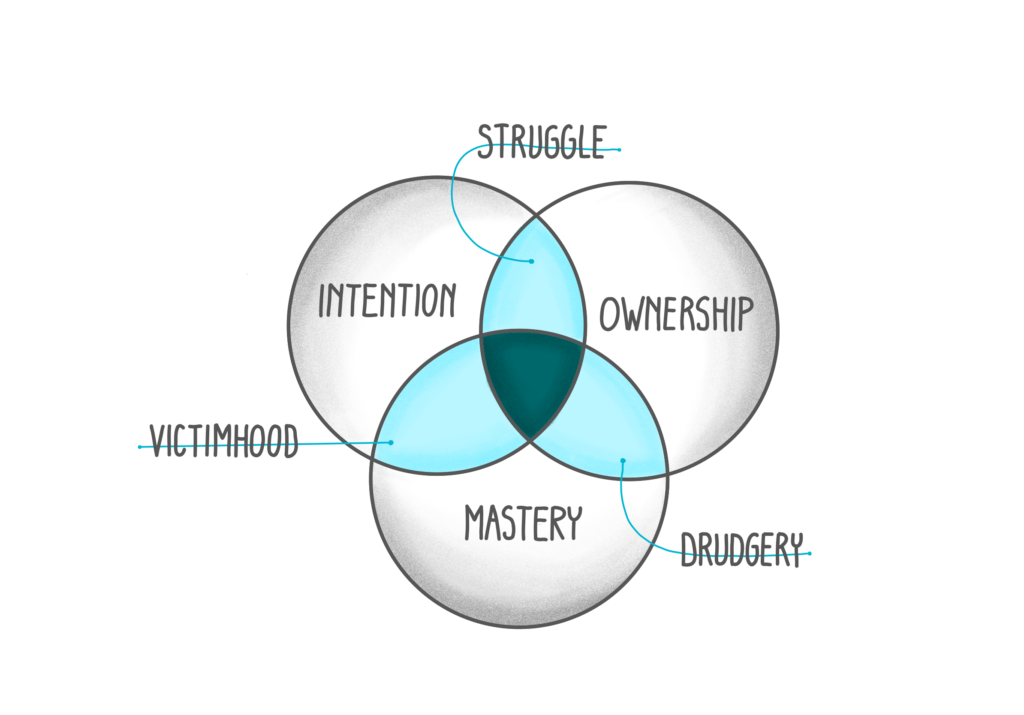
- Having Intention and Ownership, but no Mastery leads to unproductive struggle, waste of energy and bad quality. Having a goal and getting into action, but lacking the skill or ability creates hard work with mediocre results, a waste of energy and resources.
- In presence of Ownership and Mastery, but lacking Intention leaves you in a drudgery without a sense of purpose. You feel responsible, and you are capable to execute the work, but it leaves you emotionally empty as you go through the motion on autopilot.
- Finally, Intention and Mastery without Ownership leads you feel a victim without a sense of control. You seek for reasons for your stalling progress outside yourself, blaming others, circumstance, or bad luck that you don’t move towards your goals.
But what if even two elements are missing?
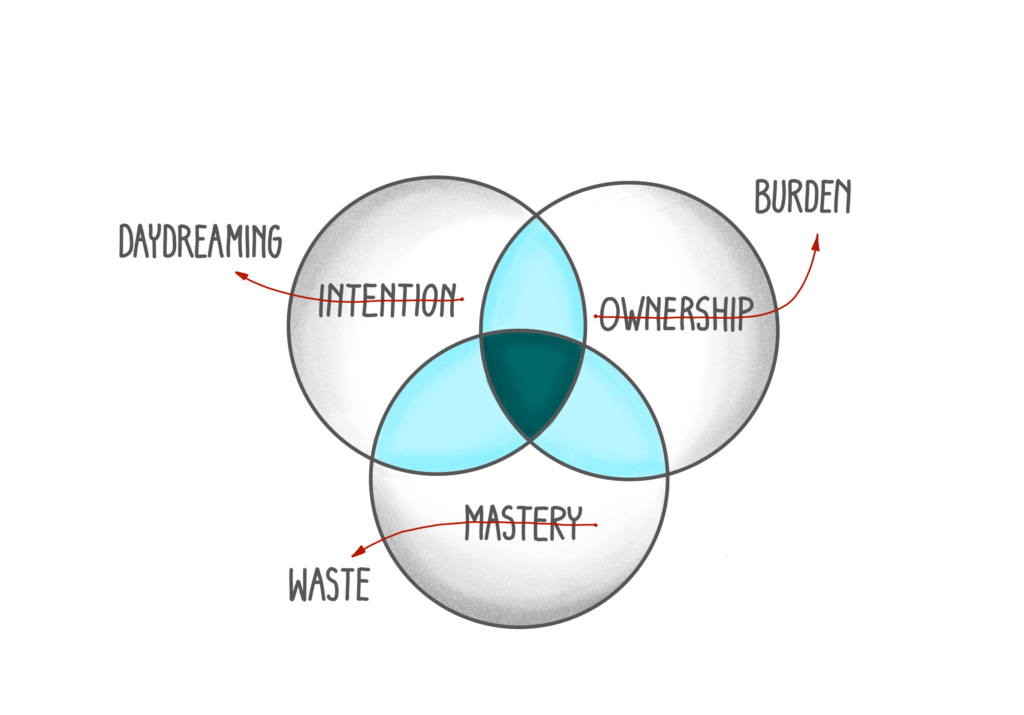
- Intention alone leads to daydreaming. Without any impulse and know-how to act on your dreams, ideas remain ideas. You’ll get stuck in endless aspiration, postponing action to tomorrow. You might start but never finish.
- Ownership alone without intention or mastery is a big burden. Taking responsibility without purpose or skill leads to stress, inefficiency, and exhaustion. You work hard but feel trapped, lacking fulfilment or competence. Ownership alone means passionless duty, a joyless weight on your shoulders.
- Mastery alone, skill without direction or investment into a higher goal is waste. If talent is underutilized, it stagnates and deteriorates. It’s a tragedy, an abandoned gold mine, deceiving yourself and society from fulfilling an existing potential.
Let’s summarize: Serene Performance is a deliberate balance of all three ingredients – Intention, Ownership, and Mastery. Each on its own is noble, two together are great – but only if all three unite, you can expect to advance smoothly.
By cultivating all three elements, you unlock a state where your work is both highly productive and deeply fulfilling, leading to effortless excellence.
Next, let’s explore how to apply the framework.
Serene Performance, small scale
Imagine your dreaded Wednesday team meeting. The one you have every week. The one you… hate. Your boss has all of you report progress, and your colleagues brag about their accomplishments. You are glad that this meeting is online, so you can multitask without anybody noticing.
Let’s look at this meeting through the lens of Serene Performance.
Version 1 – small action:
Intention: You want to survive without wasting too much energy. You don’t want to rock the boat and just comply with your boss’s rules.
Ownership: You get creative how you can use the time as best as possible without annoying your boss.
Mastery: You learn to structure your work so that you can get (other) things done while you attend the meeting. You keep low-engagement tasks on a “Wednesday” list, to be done while your colleagues are chatting.
Version 2 – big action:
Intention: You want to get rid of the time waste altogether, contributing to a better team culture and higher overall productivity.
Ownership: You plan to suggest a transition to a new meeting format, for example working with some visual structure to make the meeting more effective.
Mastery: Based on your idea, you start a stakeholder communication, with a plan to build some coalitions with your colleagues. You work on your storytelling and prepare for a pitch to your boss, convincing her to change the meeting format so that she will get better information while wasting less time.
You might judge version 1 as opportunistic and short-sighted. And you might be right that this is not the best solution to deal with the ineffective meeting. BUT: Instead of complaining about the meeting, you take ownership and come up with ways of better using the time.
You might like version 2 much better, and rightfully so. The challenge is bigger, however. With a strong intention to improve the situation within a much larger frame, you don’t complain nor gossip but activate collaborators to support you in changing the way things are done generally. To succeed, you work on your stakeholder management capabilities, also activating other people’s expertise to join forces.
It’s a balancing game. Small action vs. big action. Small effort vs. big effort. Costs vs. benefits.

Whichever version you decide to pursue, you activate intention, ownership and mastery to improve the situation.
Serene Performance, large scale
While the previous examples were profane, Serene Performance can be applied at a larger scale, for instance looking at your entire life.
Intention is about finding your life’s vision and purpose, setting meaningful goals and get clear on your role in this world
Ownership means to take control over your actions, follow the plans you make despite adverse conditions or difficulties.
Mastery is the lens you can look through in determining where you are lacking the skill or abilities to make things happen more easily, to gain momentum, do things more effectively.
For each of the three ingredients, you can apply several techniques and methods to help you achieve Serene Performance.
Practicing Serene Performance as a perpetuum mobile
Consider Serene Performance recursive – it is a toolbox which you can apply to itself to make it better over time.
You could for instance learn to master your intentions.
Or you can work on your skills as you own your mastery. It may sound confusing at first, but it makes sense when you think about your mind as a system.
This is about the meta-skill of getting better at self-improvement.
To continue the series, read part 4 here.
Get in Touch
What’s on your mind today? Share your thoughts and let’s connect.